On Aches!
We can acknowledge the ache when it arrives without giving it permanence... We do not have to glorify what hurt us to prove we survived it.

When the Ache Learns Its Place
“When the old ache arrives, I remind it that we live differently now. We eat, we rest, we ask for help. We do not build altars to what hurts us. We build mornings around sunlight, and the sound of our own name said kindly. The ache learns its place, and I learn mine.” - Izzie Babea
I came across these quotes on my Instagram feed recently, and it instantly felt like what I have subtly known but couldn’t put into words yet. It somewhat captures the core of my experiences last month.
You see, I have come to realise that some months do not announce themselves as difficult. They simply arrive and begin to take up space, quietly at first, then all at once. Last month felt like that for me.
I felt emptied in a way that was hard to name. Stretched thin across obligations, expectations, and the invisible pressure to keep performing at a level that still somehow never feels like enough. I kept asking myself: what exactly am I juggling, and why does it feel like I cannot put anything down? The harder question followed close behind: what is all of this for?
There are moments when purpose feels distant, almost like it belongs to someone else’s life. Calling becomes faint. The grind, however, does not. It remains steady, insistent, indifferent to how tired you are when you wake up. And even when I know the answers to my own questions, I still ask them, because sometimes naming the tension is the only way to stay honest inside it.
A few weeks into the month, I fell in my bathroom. A simple thing, really, just a slip on the tile from a misstep. I bruised my legs, banged my back, and missed hitting my head on the toilet by a few inches.
Thankfully, it was nothing catastrophic, but it left me strangely unsettled. Later, I told a friend about it, not because it was overly significant, but because it felt like the kind of small incident that carries an emotional echo. I remember thinking: Don’t I already have enough pain to deal with? That thought stayed longer than the bruise.
Around the same time, I found myself scrolling through social media, seeing story after story of people surviving things far heavier than a fall in a bathroom; accidents, losses, near-misses, recoveries that never quite return you to who you were before. In that moment, something shifted. Not into clarity exactly, but into perspective.
I felt grateful. Not because my month suddenly became easy, but because I could see how fragile and shared difficulty really is. We are all, in one way or another, moving through things that test our balance. We all have seasons that knock us off rhythm. We all juggle more than we admit. We all stumble.
And somehow, that recognition softens the edges. It does not fix the month. It does not erase exhaustion or resolve uncertainty. But it makes it lighter to carry. There is a quiet relief in realising that struggle is not a private language you alone are forced to speak. It is human grammar.
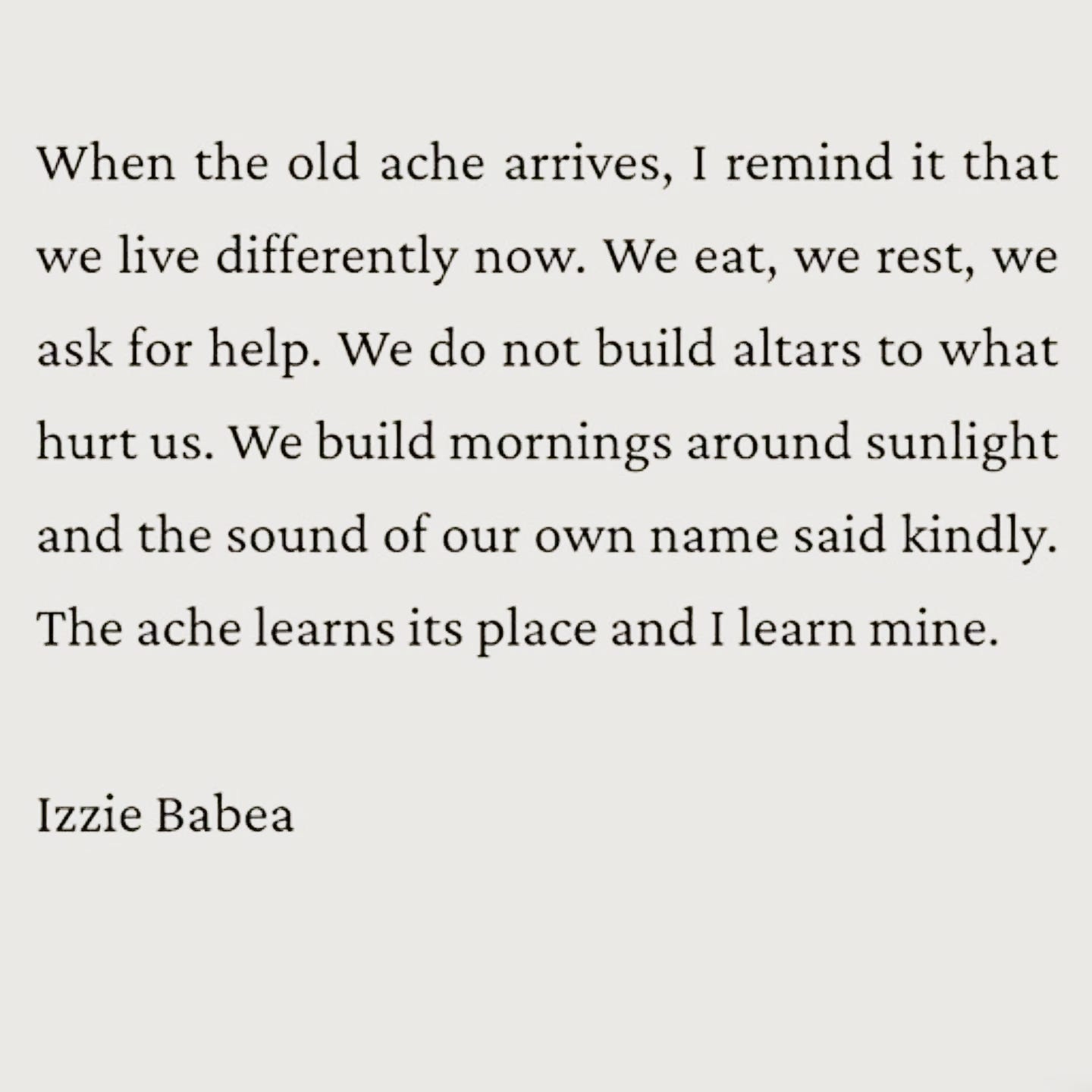
And so I return to that opening quote: We do not build altars to what hurts us.
We do not have to. We can acknowledge the ache when it arrives without giving it permanence. We can let it sit, learn from it, and then return it to its place. Not erased. Not glorified. Just contained.
Because there is another way to live alongside it now. We eat. We rest. We ask for help. We build mornings around sunlight, and the sound of our own name said kindly.
The ache learns its place, and slowly, so do we.
What the month taught me is that the ache doesn’t need to disappear for life to feel livable again. It only needs to learn its place. I don’t have to build my whole day around it, nor do I have to pretend it isn’t there. I can let it sit in the corner of the room while I eat breakfast, take a walk, answer a text, laugh at something small. The ache gets quieter when it’s no longer the centre of the story.
The shift happens when we stop performing for exhaustion and start choosing gentleness. We don’t owe our pain an audience. We owe ourselves care. That looks like asking for help before we break, resting before we collapse, and speaking to ourselves with the same kindness we’d offer a friend who fell in their own bathroom.
So here’s what I’m practising now, and maybe it helps you too: name the tension without letting it name you. Let the hard month be a season, not an identity. Let gratitude and grief sit at the same table. Build your mornings around what restores you: sunlight, water, a quiet name spoken kindly, and let the ache learn that it is not in charge here.
We do not have to glorify what hurt us to prove we survived it. We only have to keep living, softly, until the ache learns its place. And slowly, we learn ours too.
My back still aches when I think about it, but I no longer feel the hurt as much. And we are back at it again for the new month.
Till some other time,
- Mustapha Lawal
